Are You Leading Like an Owner or a Steward? | The Ripple of the Week
The Ripple of the Week
Are You Leading Like an Owner or a Steward?
Owning a business and stewarding a business are not necessarily the same thing.
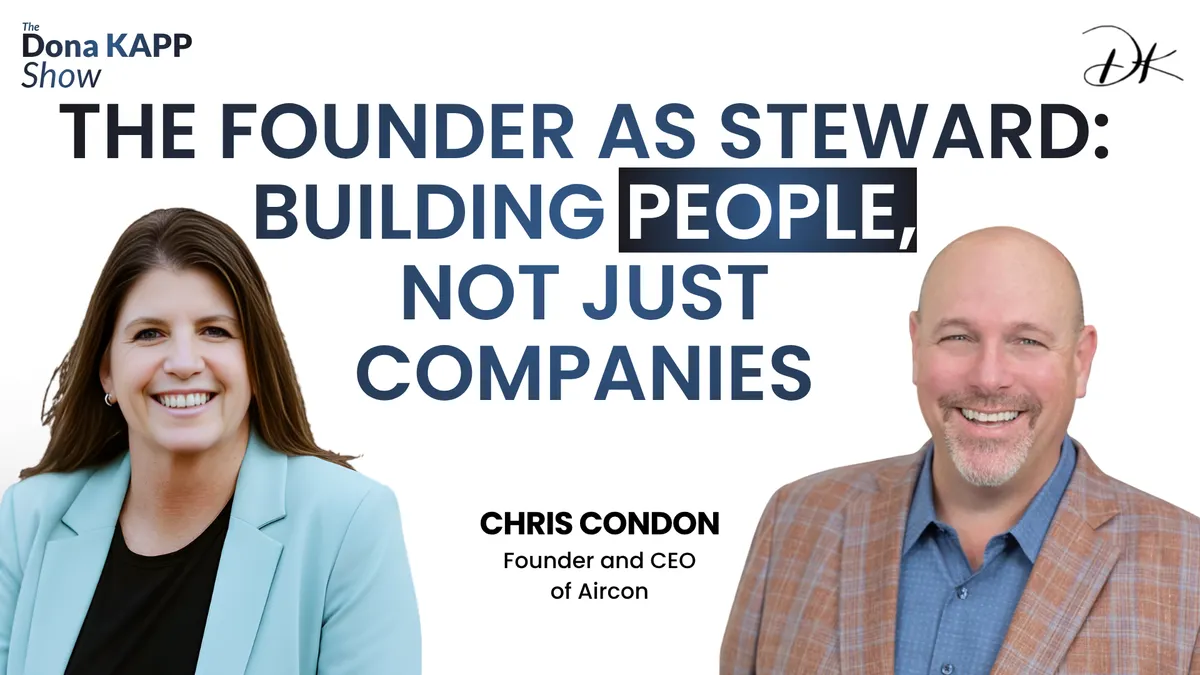
That was one of the ideas that stayed with me after my conversation with Chris Condon, Founder and CEO of AirCon, on The Dona KAPP Show.
Chris made a distinction that I think every business owner and leader should consider.
Ownership is a legal condition.
Stewardship is a behavioral obligation.
A founder may own the equity, but a business carries far more than the interests of the person whose name is on the paperwork. It carries employees’ livelihoods, commitments to customers, investors’ trust, and often years of sacrifice made by families and other people who helped build it.
That changes the question from:
“What do I want from this business?”
to:
“What am I responsible for protecting, developing, and leaving stronger than I found it?”
Leadership Is About More Than the Outcome
Chris grew up between two very different worlds.
His mother was a pioneering female corporate executive, while his summers were spent on a Wisconsin farm.
As he described it, the farm taught him something simple: titles didn’t matter very much when the cows still needed to be milked and the work still needed to get done.
Looking back, he realized those experiences helped shape his understanding of leadership as responsibility, not simply position or outcome.
I think that distinction matters.
It is easy for leaders to become consumed by results.
Revenue.
Growth.
Profitability.
Market share.
Those things matter. A business has to perform.
But stewardship asks us to consider something else:
How are we producing those results, and what are we building in the process?
Sometimes Stewardship Requires the Hard Decision
Being a steward does not mean making everyone happy.
Chris and I talked about one of the hardest parts of leadership: genuinely caring about people while still making decisions that protect the long-term health of the company.
His perspective was straightforward.
If the company does not survive, nobody has a job.
There are times when leaders have to separate friendship from their responsibility to the organization. There may be difficult conversations, economic decisions, or situations where someone is no longer contributing what the business needs.
Chris talked about trying to think several steps ahead:
How will this affect the business?
How will it affect the people?
What might happen next?
There is rarely a perfect answer. Leadership requires making the best decision you can with the information you have and continuing to learn from the consequences.
That is part of stewardship too.
You Cannot Control Every Outcome
Another part of our conversation really connected with me.
As business owners, we like to believe we can control the outcome.
If we work harder, sell harder, plan better, or push a little more, surely we can make the result happen.
But we cannot control whether a customer buys.
We can control the value we create, the processes we build, how we lead our people, how we communicate, and how well we serve.
Chris described a shift in his own thinking from chasing the outcome to concentrating more on what he could actually control inside the business.
That is an important distinction for leaders.
Sometimes our responsibility is not to guarantee the outcome.
Our responsibility is to steward the inputs well enough to give the organization the best opportunity to succeed.
Maybe Legacy Is Who Grows
Toward the end of our conversation, we talked about legacy.
Chris said that some of the greatest satisfaction in his career has come from seeing other people grow into managers, leaders, and larger responsibilities.
Then he shared a story that brought the idea home.
Someone he had worked with many years earlier contacted him to say that one of his old lessons was still being taught to people in the organization.
Chris hadn’t set out to create some grand legacy in that moment.
He had simply been leading.
But the lesson kept moving.
From one person to another.
Years later.
That is the ripple.
And it raises a different way of thinking about success.
Maybe legacy is not only what you built.
Maybe it is also who grew because you were there.
This Week’s Ripple Question
If you stopped thinking like the owner of your business and started thinking like its steward, what would you do differently?
Would you develop someone instead of doing the work yourself?
Would you have a conversation you have been avoiding?
Would you make a difficult decision that protects the organization five years from now instead of making today easier?
Would you spend more time thinking about the people who will eventually carry the work forward?
Ownership tells us what belongs to us.
Stewardship asks us what has been entrusted to us.
That may be one of the more important questions we can ask ourselves as leaders.
Watch the Full Conversation
This Ripple was inspired by my conversation with Chris Condon, Founder and CEO of AirCon, on The Dona KAPP Show.
We talked about leadership, stewardship, family, AI, human judgment, difficult decisions, and how our impact often continues through people in ways we may never fully see.
Watch the Full Conversation → Are You Leading Like an Owner or Steward
Remember...
Every decision, every relationship, and every action sets a ripple in motion, and who you become amplifies the ripple you create.
So go out and make yours a big, bold, and positive one.
Dona Kappmeyer
Host, The Dona KAPP Show