Before You Blame the Person, Look at the System | The Ripple of the Week
Before You Blame the Person, Look at the System
When something goes wrong in a business, where do we usually look first?
At the person.
Who missed the deadline?
Who made the mistake?
Who didn't follow through?
Who isn't producing?
Who dropped the ball?
It's understandable. People are visible. They're easy to identify. And when there's a problem, we naturally want to find the source and fix it.
But what if the person isn't actually the problem?
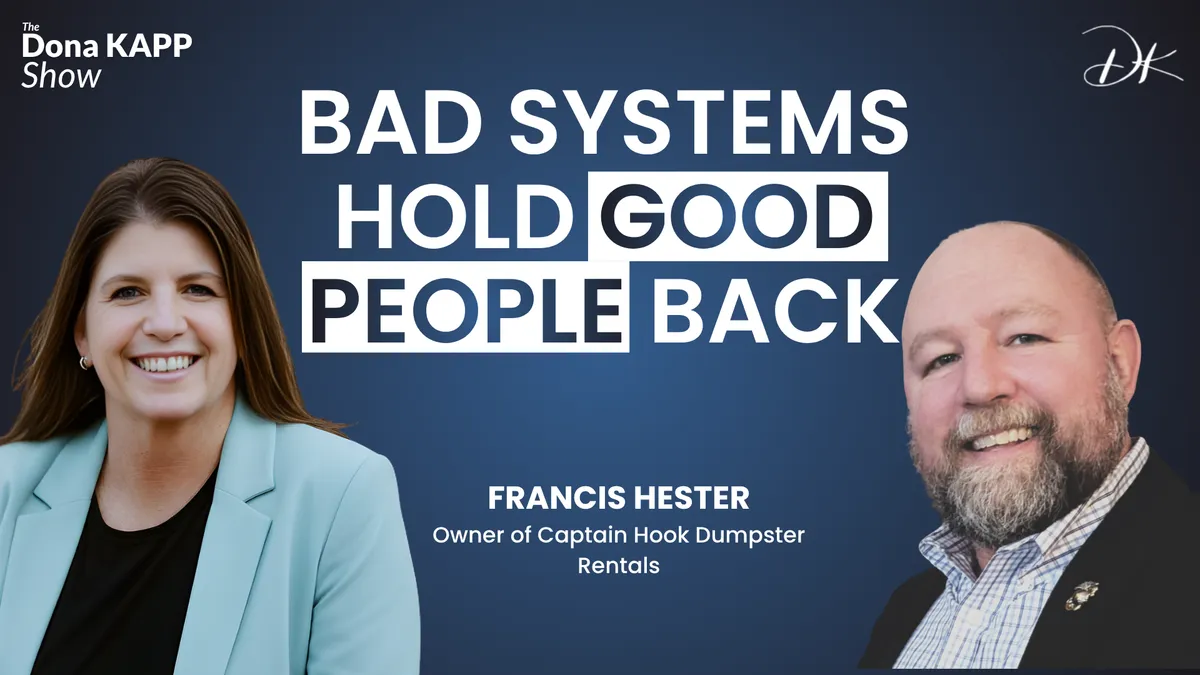
That question stayed with me after my conversation with Francis Hester, owner of Captain Hook Dumpster Rentals, on The Dona KAPP Show.
Francis put it simply:
Bad systems hold good people back.
And I think that's worth sitting with.
Most People Want to Win
Francis shared something during our conversation that I believe most leaders need to hear.
In his experience, people are generally smart, capable, and want to do a good job.
They want to win.
They want to be part of a winning team.
But put good people inside a poorly designed system and eventually you're going to see frustration, conflict, missed expectations, and poor performance.
The easiest conclusion is:
We have a people problem.
But sometimes the person you're looking at is simply where the problem finally became visible.
The actual cause may have started much earlier.
The Problem May Be Upstream
Imagine your collections team is struggling to collect payments.
Easy conclusion?
Collections needs to improve.
But what if sales brought in customers who were poor credit risks?
Now it looks like a collections problem, but the problem started upstream.
Or maybe your operations team can't deliver what sales promised.
Easy conclusion?
Operations isn't performing.
But what if sales is incentivized only to sell more, regardless of whether the work is profitable, realistic, or something your team can deliver well?
Now two departments can be doing exactly what you've asked them to do and still be working against each other.
That's the danger of looking at individual parts of the business without looking at how they interact.
Your business isn't a collection of independent departments.
It's a system.
Marketing affects sales.
Sales affects operations.
Operations affects customer experience.
Customer experience affects retention.
Retention affects revenue.
Revenue affects cash.
And all of it affects your people.
A decision that makes one department look more productive can actually make the overall business perform worse.
Don't Confuse the Symptom With the Cause
This is where leadership gets difficult.
The place where you see the problem isn't necessarily where the problem started.
A missed deadline may be a time-management issue.
Or the employee may have five competing priorities and no clarity about which one matters most.
Poor customer service may be an attitude problem.
Or the team may be dealing with a process that repeatedly creates frustrated customers before they ever reach the employee.
Low sales may be a sales problem.
Or it may be a lead-generation problem.
Or a pricing problem.
Or a fulfillment problem that's causing existing customers to leave.
Or a capacity problem that is keeping the organization from accepting the right work.
Before you fix the person standing closest to the symptom, step back.
Look at the whole system.
Are Your People Working Against Each Other?
Here's another question worth asking:
Have you accidentally designed a business where good employees have competing definitions of success?
Sales gets rewarded for selling more.
Operations gets rewarded for controlling costs.
Customer service gets rewarded for resolving issues quickly.
Finance gets rewarded for protecting cash.
Individually, those goals may make sense.
But what happens when maximizing one creates problems for another?
That's when you hear:
“Sales keeps selling things we can't deliver.”
“Operations is making it impossible for us to close deals.”
“Finance won't approve anything.”
“Customer service keeps giving things away.”
And suddenly you've got departments blaming one another.
The problem may not be the people.
The system may be producing exactly the behavior it was designed to produce.
Sometimes Leadership Creates the Bottleneck
This is the uncomfortable part.
Business owners are part of the system too.
We can create confusion by constantly introducing new priorities.
We can tell the team to focus and then give them five new initiatives.
We can ask employees to follow a process and then bypass it ourselves.
We can reward individual performance while talking about teamwork.
We can tell people we want them to think independently and then override every decision they make.
And then we wonder why the organization feels stuck.
One of the most interesting things Francis described was what happened when his team finally understood how the whole business worked together.
They became more comfortable challenging him.
When he suggested something that didn't support the overall goal, they could push back.
That's not insubordination.
That's ownership.
When people understand the system, they stop simply completing tasks and start thinking about what is best for the business.
That's a very different level of engagement.
Before You Add Another Solution
Business owners are surrounded by solutions.
New software.
New hires.
New compensation plans.
New training.
New marketing.
New technology.
New processes.
Some of those may be exactly what you need.
But before you add something else, ask:
What is actually constraining the business right now?
Because improving something that isn't the constraint may make you busier without making the business better.
You can widen six lanes of highway, but if everything eventually has to cross a two-lane bridge, the bridge still determines how much traffic gets through.
Find the bottleneck.
Then focus your attention there.
A Better Leadership Question
The next time somebody on your team makes a mistake or performance falls short, accountability still matters.
This isn't about eliminating personal responsibility.
It's about making sure you're solving the right problem.
Instead of immediately asking:
“What's wrong with this person?”
Try asking:
“What is happening in the system that may be contributing to this result?”
Then look upstream.
Look downstream.
Talk to the people actually doing the work.
Ask where things get stuck.
Ask which priorities compete.
Ask what they work around every day.
Ask what doesn't make sense anymore.
You may discover that the person you've been trying to fix has been fighting the system the entire time.
The Ripple
Better systems do more than improve efficiency.
They change how people experience work.
There is less unnecessary conflict.
Expectations become clearer.
People understand how their decisions affect others.
Teams collaborate rather than compete.
Employees gain the confidence to challenge decisions that don't support the overall goal.
And good people finally have an environment where they can do good work.
That's the ripple.
Ripple Question
Where in your business might you be blaming a person for a problem the system is actually creating?
Take one recurring frustration this week and look at it differently.
Don't start with who.
Start with why.
Then follow the problem through the entire system.
You may be surprised by where it actually begins.
🎙️ Want to hear the full conversation?
Watch my conversation with Francis Hester on The Dona KAPP Show: Business, Life & The Ripple Effect.
Watch the Episode → Francis Hester | Bad Systems Hold Good People Back
Who you become amplifies the ripple you create. Go out and make yours a big, bold, and positive one